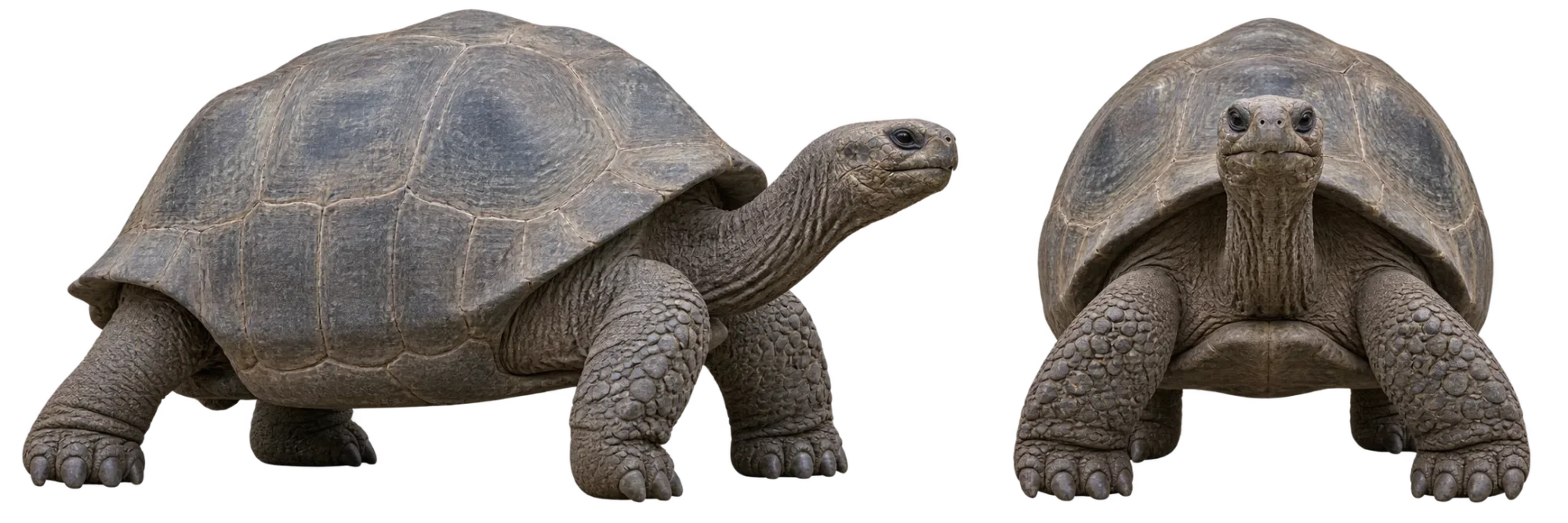
Aldabra giant tortoises spend roughly two decades or more growing before reproduction becomes regular, and females may then breed across many decades. In Aldabrachelys gigantea, the timing and output of reproduction can shift with population density, rainfall, food availability, and nest conditions, so life-history values are better understood as ranges shaped by the environment rather than fixed numbers.
Maturity Depends on Growth Conditions
Sexual maturity comes late in the Aldabra giant tortoise. Historical field work on Aldabra placed female maturity at roughly 17–23 years, while zoological institutions commonly use an estimate closer to 25–30 years. These figures describe a naturally variable process rather than a precise birthday at which every tortoise becomes reproductive.
Growth conditions help explain part of that variation. Studies of separate tortoise populations on Aldabra found that animals living at different population densities did not mature in exactly the same way. Higher density was associated with later sexual maturity, while adult body size also differed between populations. Access to food and competition therefore affect how quickly an individual reaches the reproductive stage.
Young males and females are also difficult to distinguish externally. Adult males eventually tend to become larger, develop a longer and thicker tail, and have a more concave plastron. Those sex differences emerge gradually as the animals mature, which is one reason the sex of juveniles may remain uncertain for many years.
Rainfall and Density Shape Reproductive Output
Female Aldabra giant tortoises do not produce the same number of eggs every year. Research on wild populations has shown that reproductive effort changes with local crowding, rainfall, and the amount of food available.
In lower-density areas, females can lay more than one clutch during a favorable breeding period. Where tortoises are crowded and resources are under greater pressure, fewer mature females may breed, individual clutches can be smaller, and the interval between nesting attempts may increase. Historical studies recorded clutch sizes reaching the twenties, but such upper values should not be treated as the normal output of every female.
Clutch Size Is Environment-Sensitive
A clutch count describes one nesting event. It does not by itself show how many clutches a female produces in a year, how many eggs are fertile, or how many young eventually hatch. All of these stages can vary independently.
Rainfall matters because it affects vegetation and food supply across Aldabra. Changes in feeding conditions can influence whether females invest in reproduction and how much they invest. This makes breeding output unusually responsive for an animal whose individual lifespan can extend well beyond a century.
Incubation Time Varies Across Nests and Populations
After mating and egg development, the female digs a nest and buries the clutch. The eggs then develop without parental care. Historical observations from Aldabra recorded incubation periods of about 98 to 148 days, roughly three to five months.
That range is not universal. More recent work across Aldabra and other Seychelles populations has allowed considerably longer monitoring windows because development can take longer under some environmental and managed conditions. Zoological records have also reported incubation approaching eight months in some cases.
Temperature, moisture, soil conditions, and local weather can alter development inside the nest. For that reason, an incubation value from one site should not automatically be applied to every Aldabra giant tortoise population. A long incubation period also does not necessarily mean that an egg is developing normally; the final outcome must be confirmed by hatching or examination of the egg.
Recent Nest Data Show Variable Recruitment
The long lives of adult Aldabra giant tortoises can make population condition difficult to judge from adult numbers alone. Adults may remain present for decades even when relatively few young animals are being added to the population.
A 2026 study examined 24 clutches from a naturally occurring population on Picard Island in Aldabra Atoll and five translocated Seychelles populations. Across the 317 monitored eggs, 16% hatched. Results differed sharply by location: the monitored Picard clutches had a 46% hatching rate, while several translocated populations recorded much lower success during the sampled seasons.
Two-thirds of the monitored clutches produced no hatchlings. Laboratory examination of undeveloped eggs also indicated that early embryo loss, rather than fertilization failure alone, contributed heavily to unsuccessful development. The sample was limited and covered only a small number of nesting seasons, so these percentages should not be treated as permanent species-wide rates.
The findings add an important distinction to the tortoise’s life history. Producing a clutch, producing fertile eggs, completing embryonic development, and recruiting young tortoises into the population are separate stages. A population can contain many long-lived adults while conditions affecting eggs and young animals change much sooner.