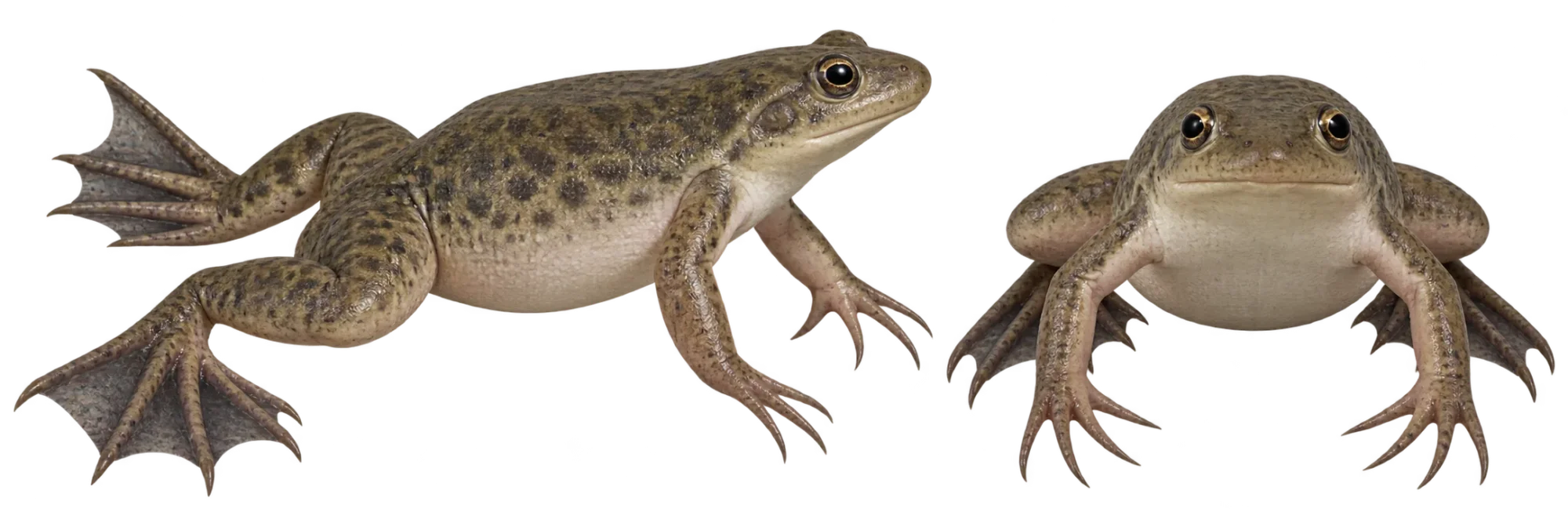
The African clawed frog (Xenopus laevis) can move from a newly fertilized egg to a small froglet within a matter of weeks, yet reproductive adulthood takes much longer. Its life cycle is shaped by repeated aquatic spawning, very fast embryonic development, a temperature-sensitive tadpole period, and a comparatively long adult life.
Spawning Responds Quickly to Favorable Water Conditions
Reproduction takes place entirely in water. Male African clawed frogs produce their mating calls underwater, and receptive females can answer with a distinct call of their own. During mating, the male holds the female around the pelvic region in pelvic amplexus, rather than the position nearer the forelimbs seen in many other frogs.
Breeding is flexible rather than tied to one narrow date everywhere the species occurs. Wild populations respond to local rainfall and seasonal changes, while work with captive frogs shows that reproductive activity can occur through much of the year when temperature, nutrition, and water conditions are suitable. Freshly filled water bodies and changes in water level can also act as breeding cues.
Females lay sticky eggs that are fertilized externally as they are released. Published egg counts vary widely. Depending on female size, population, and breeding conditions, a spawning can involve hundreds to many thousands of eggs. This variation makes a single clutch-size figure less informative than it might appear for a species whose reproductive output changes so much among females and settings.
Laboratory reproduction adds another layer to the picture. Ovulation can be induced with gonadotropins, allowing females to produce large numbers of eggs on demand after suitable rest periods. These induced spawnings are useful for research, but they should not be treated as a direct measure of how often an individual would reproduce spontaneously in the wild.
Early Development Is Fast, While the Tadpole Period Is More Variable
The large eggs of Xenopus laevis begin dividing soon after fertilization, and embryonic development proceeds rapidly. Hatching can occur within roughly two to three days, with the exact pace affected by temperature. The young larvae then enter a feeding stage as highly specialized filter-feeding tadpoles.
These tadpoles differ sharply from the predatory and scavenging adults. They collect suspended food from the water while growing through a sequence of well-described developmental stages. Hind limbs appear first, followed later by the forelimbs, while the body prepares for the transition from larval feeding and swimming to the frog form.
The full trip from egg to froglet is often reported at about six to ten weeks, but this is not a fixed biological deadline. Temperature, food supply, water conditions, and husbandry can alter the pace. Experimental work has produced froglets in around five weeks under favorable conditions, while other individuals take considerably longer.
Metamorphic Climax
The final phase of metamorphosis is much shorter than the entire tadpole period. Once the climax begins, the remaining transformation takes roughly a week under commonly used laboratory conditions. During this stage the tail is resorbed and the animal completes the shift to the juvenile frog body plan.
Reproductive Maturity Comes Months After Metamorphosis
A newly metamorphosed African clawed frog is still far from reproductive adulthood. Around 10 to 12 months is a commonly reported maturity range, but studies do not produce one universal age. Growth conditions and sex can change the schedule, and some laboratory work has found males capable of reproduction earlier than females.
Female reproductive development deserves particular care when comparing records. Under optimized captive conditions, females may become reproductively useful within about a year. Research following oocyte development without artificial hormonal stimulation has found a much slower first wave, with mature oocytes taking close to two years to develop. Those observations describe different biological and husbandry conditions rather than a single contradiction that can be solved by averaging the numbers.
Once mature, Xenopus laevis has the potential for repeated reproduction across a long adult life. Field estimates place longevity well beyond a decade in some populations, while exceptionally old captive frogs have been reported near 30 years. Captive maximum records represent what the species can sometimes achieve under managed conditions, not the expected lifespan of every wild frog.